

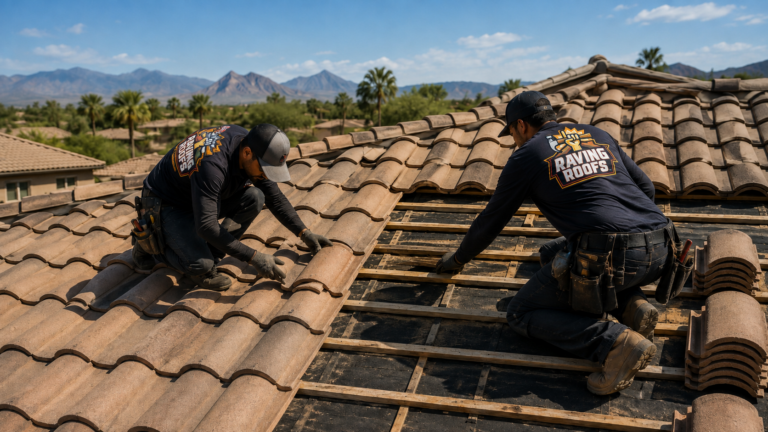
Yes, part of a roof can sometimes be replaced without replacing the entire system.
Partial replacement works best when the damaged area is clearly isolated, the roof has a natural place to stop the new work, and the surrounding roof still has meaningful life left. Sloped tile, shingle, and metal roofs are often easier to divide into sections because their slopes, ridges, hips, and walls create clearer boundaries.
Flat and low-slope roofs can be more difficult. Water may enter in one location, travel beneath the roof system, and appear inside the home somewhere else. That can make the true extent of the problem harder to isolate.
A partial replacement should solve a defined roofing problem without creating a weak connection between the new and existing sections.
A full roof replacement is a major expense, so it is reasonable to ask whether only the damaged section can be addressed.
Perhaps one roof slope is leaking. A storm may have damaged only one side of the home. One section may receive more sun or drainage exposure than the rest. The homeowner may also need time to prepare financially for a larger project.
In the right situation, partial replacement can reduce the immediate cost and extend the useful life of the remaining roof.
However, the decision cannot be based on square footage alone. The roofer must determine whether the damaged section can be separated from the rest of the system and connected to the existing materials reliably.
When that separation is clear, partial replacement may be practical. When the source of the problem is uncertain or the surrounding roof is already deteriorating, the smaller project may not provide lasting value.
Partial replacement is most likely to work when:
A section damaged by a falling branch may be a reasonable candidate. The same may be true when a specific roof plane was installed differently or has aged faster because of heavier sun or weather exposure.
Confidence in the diagnosis matters. A roofer should be able to show where the damage begins, where it ends, and how the transition between the old and new sections will be completed.
For help determining whether a smaller project still makes sense financially, see [Roof Repair vs Replacement in Phoenix].
Every partial replacement needs a clear boundary.
On a sloped roof, that boundary may be a ridge, hip, wall, or the end of a complete roof plane. A separate garage, patio, or addition may also create a logical section that can be addressed independently.
These natural transitions make it easier to separate the new work from the remaining roof.
Problems are more likely when the contractor has to cut through the middle of a connected roof area and create an artificial stopping point. That transition may be harder to waterproof and maintain, particularly when old materials are brittle or uneven.
A smaller project is not necessarily a simpler project. The connection between the new and old materials may require more careful detailing than a full replacement across one continuous area.
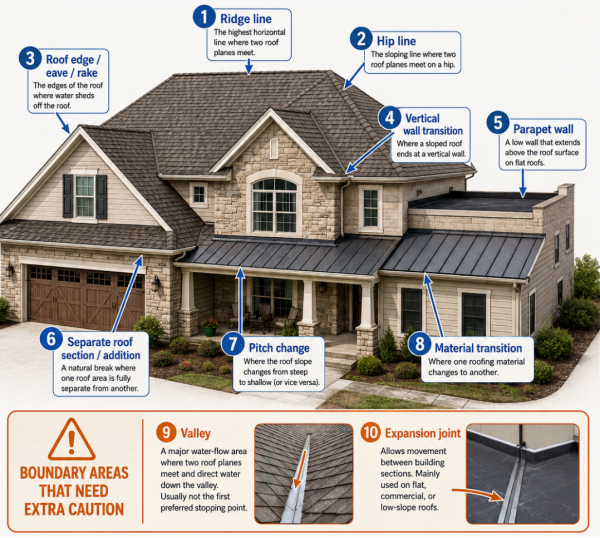
A valley is where two sloped roof planes meet and direct water toward the edge of the roof.
During a Phoenix monsoon storm, valleys can carry a large amount of water in a short time. That makes them one of the more sensitive places to connect old and new roofing materials.
Partial replacement may still be possible near a valley, but the roofer needs to evaluate the full water path. Flashing, underlayment, adjoining roof planes, and the condition of the materials on both sides can affect the decision.
A poor tie-in through a valley may leave a vulnerable seam directly in one of the roof’s busiest drainage areas.
When a valley is involved, replacing a larger logical section may provide a more dependable result than stopping the work at the smallest possible area.
Partial replacement provides the most value when the surrounding roof is expected to remain serviceable for several more years.
If the rest of the roof is already near the end of its life, replacing one section may begin a cycle of repeated projects.
One area is replaced this year. Another starts leaking after the next monsoon season. A third section develops a problem the following year.
Each visit brings additional costs for inspection, setup, labor, materials, property protection, cleanup, documentation, and project management.
Phasing the work may still be necessary when budget is the primary constraint. The homeowner should simply understand whether the partial replacement is expected to provide a lasting solution or help buy time before a broader project.
For more on the cost of replacing the entire roof, see [How Much Does a Roof Replacement Really Cost in Phoenix?].
Tile roofs can sometimes be replaced by slope or section because their design often creates defined roof planes.
If one slope has a confirmed problem and the surrounding underlayment remains in good condition, the tile can be removed from that area, the waterproofing rebuilt, and the reusable tile reinstalled.
The difficulty is that tile can hide the true condition of the roof.
Concrete and clay tiles may still look good while the underlayment beneath them has become dry and brittle. A homeowner may see one ceiling stain, but an inspection may reveal that the waterproofing is deteriorating across several sections.
Partial tile replacement is most dependable when the underlayment problem is truly limited and the new waterproofing can connect to healthy existing material.
It becomes less attractive when the new section would be tied into underlayment that is already weakening.
For more on why hidden roof components may age before the visible surface, see [Why Roofs Fail Faster in Phoenix (Even When They Still Look Fine)].
Shingle roofs may also allow one slope or damaged section to be replaced.
Matching can be difficult after years of Phoenix sunlight. Even when the same brand and color remain available, new shingles may look noticeably different from older, faded materials.
The condition of the surrounding shingles matters even more than appearance.
Older shingles may be brittle and may crack or break as the crew lifts them to connect the new section. Weakened seals can also make it difficult to create a dependable transition.
A partial shingle replacement is more likely to work when the adjoining materials remain flexible and the damage ends at a clear roof boundary.
If brittleness and granule loss are widespread, the work may disturb more of the existing roof than expected.
Foam and other low-slope systems can sometimes be repaired or replaced in sections, but the diagnosis is often more complicated.
Water does not always travel straight downhill on a flat roof. It may move beneath the coating or roofing membrane before appearing inside the home.
A stain in one room may therefore come from a defect several feet away.
The roofer also needs to evaluate:
A partial foam repair may be effective when the damaged area is isolated and the surrounding system remains dry and stable.
When the coating is deteriorating across the roof or moisture has spread beneath the foam, a small section may not address the larger issue.
For more information about foam projects and pricing, see [How Much Does a Foam Roof Cost in Phoenix].
Metal roofs are built from panels, seams, flashing, fasteners, and transitions that work together.
Replacing part of a metal roof may be possible when the affected panels can be removed cleanly and the surrounding system remains in good condition.
However, panel layout can complicate the project. A damaged area near a seam, wall, valley, penetration, or concealed fastening system may require removing more material than expected.
Matching the panel profile, finish, and color can also be difficult on an older roof.
Metal expands and contracts as temperatures change, so the transition between the new and existing panels must allow the system to move as designed.
The roofer should evaluate the full panel layout before promising that only a small area will need replacement.
A newly installed roof section begins its life next to materials that may have already spent 10, 15, or 20 years in Phoenix weather.
The older materials may be faded, brittle, less flexible, or more difficult to seal.
That can affect both appearance and performance.
New shingles may not match the old color. New coating may bond differently from weathered coating. Old underlayment may be less dependable at the connection point. Existing flashing may not perform as long as the new section.
These differences do not automatically rule out partial replacement.
They do affect how the project should be designed, what can reasonably be warrantied, and how long the combined system is likely to perform.
Warranty coverage is usually more limited when only one section of the roof is replaced.
A contractor may be able to provide workmanship coverage for a complete slope or clearly defined area. That warranty applies to the new work, not necessarily to the older sections that remain.
A small patch may carry even narrower coverage.
For example, a contractor may warrant the workmanship on a repaired flat-roof area without guaranteeing that water cannot enter elsewhere and travel beneath the system.
Before approving partial work, ask:
A clear warranty sets realistic expectations and helps prevent confusion later.
Partial replacement becomes riskier when the leak source has not been confirmed, the roof is aging in several areas, or there is no reliable place to end the new work.
Other concerns include brittle surrounding materials, difficult valleys, unavailable matching products, poor drainage, widespread moisture, and unclear warranty boundaries.
In these conditions, replacing the smallest possible section may not be the most economical choice.
The homeowner could pay for work that fails to stop the leak, damages adjoining materials, or needs to be removed when the remaining roof is replaced soon afterward.
A good contractor should explain those limitations before the work begins.
Not every homeowner is financially prepared for a full roof replacement when a problem appears.
Depending on the condition of the roof, several options may still be available.
A targeted repair may be appropriate for one isolated defect. Partial replacement may address a complete slope or clearly separated section. Temporary work may provide limited protection while the homeowner prepares for a larger project.
Some roofs can also be replaced in logical phases.
The contractor should explain how long each option is expected to last and what risks remain after the work is complete.
A temporary solution should not be described as permanent. Partial replacement should not be presented as equal to replacing the full system when the remaining roof is already deteriorating.
The best option is the one that fits the roof’s condition, the homeowner’s budget, and the amount of time the solution needs to provide.
A partial replacement decision should begin with a full inspection of the affected area and the surrounding roof.
The inspector should determine:
The visible damage is only one part of the decision.
For a fuller explanation of the inspection process, see [What to Expect During a Roof Inspection].
Before agreeing to partial replacement, ask the contractor to explain the recommendation clearly.
Useful questions include:
The answers should make the limits and benefits of the project easy to understand.
Replacing only part of a roof can be a sensible option when the damage is clearly contained, the roof has a natural stopping point, and the remaining system still has meaningful life left.
Sloped roofs are often easier to divide into complete sections. Flat and low-slope roofs can be harder to isolate because water may travel beneath the system before becoming visible inside.
Partial replacement becomes less practical when the leak source is uncertain, surrounding materials are deteriorating, valleys complicate the connection, or the remaining roof is likely to need replacement soon.
The decision should balance the immediate cost with the expected life of both the new and existing sections.
Schedule an inspection with Raving Roofs before deciding how much of the roof to replace.
We will evaluate the damaged area, the condition of the surrounding roof, the available transition points, and the likely warranty limitations.
You will then be able to compare repair, partial replacement, and full replacement based on what each option is realistically expected to accomplish.