

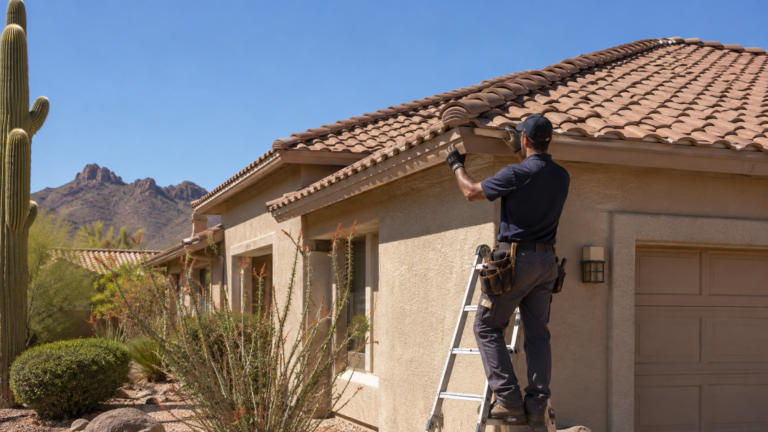
Roofs in Phoenix often age faster because of extreme heat, ultraviolet exposure, daily expansion and contraction, attic temperatures, dust, monsoon storms, and long-term environmental stress.
But climate is only part of the story.
A roof’s lifespan also depends heavily on how well it was installed. A premium material installed poorly can fail much earlier than expected, while a more basic system installed correctly and maintained over time may perform well for decades.
That is why two roofs in the same neighborhood, built at about the same time, can age very differently.
The visible surface may still look normal while underlayment, flashing, sealants, coatings, fasteners, or drainage details are quietly deteriorating underneath.
Most homeowners expect roof failure to be obvious.
They picture missing shingles, cracked tiles, visible storm damage, or water dripping from the ceiling. Sometimes roof problems do look that dramatic.
More often, Phoenix roofs age gradually and out of sight.
A tile roof may still look attractive from the street while the waterproof underlayment beneath it has become dry and brittle. A shingle roof may lie flat while its seals and asphalt have weakened. A foam roof may look mostly intact from the ground even though its protective coating is becoming thin in exposed areas.
The roof may continue keeping water out until one severe storm finally exposes the weak point.
That is why appearance alone does not tell you how much life a roof has left.
Phoenix heat is extremely hard on roofing materials.
Dark roof surfaces can become much hotter than the outside air. Over time, that heat dries out asphalt, stresses sealants, accelerates coating wear, and contributes to the deterioration of waterproofing materials.
The roof also heats up during the day and cools after sunset.
That repeated expansion and contraction places stress on seams, fasteners, flashing, penetrations, and transitions. The movement is usually small each day, but it adds up over years.
Heat alone, however, does not explain why one roof fails much earlier than another.
A roof should be viewed as a complete system. The visible covering, underlayment, flashing, fasteners, penetrations, ventilation, drainage, and workmanship all have to function together.
When one detail is poorly installed, even high-quality materials may not perform as expected.
Homeowners often focus on the product being installed.
They ask which tile, shingle, foam coating, or metal panel is best. Those questions matter, but the material is only part of the answer.
The installation determines whether the components work together properly.
Underlayment needs correct overlaps and fastening. Flashing must direct water away from vulnerable areas. Penetrations need to be sealed and integrated into the roof system. Drainage must move water off the roof instead of allowing it to collect.
A higher-priced material does not compensate for poor preparation or incorrect details.
Likewise, a less expensive material installed carefully may outperform a premium material that was rushed or improperly applied.
This is one reason roofing quotes should not be compared only by the product name or final price. Homeowners should also understand how the system will be installed and who will oversee the work.
For more on what can create large differences between proposals, see [Why Some Roofing Quotes Are Cheaper Than Others].
Tile roofs are especially deceptive because the visible tile may last much longer than the waterproofing beneath it.
Concrete and clay tiles are designed to withstand years of sunlight and weather exposure. Individual tiles may crack or break, but much of the original tile can often remain serviceable for decades.
The underlayment beneath the tile is what keeps water from entering the home.
That underlayment is exposed to trapped heat, repeated thermal movement, dust, and long-term aging. Over time, it may become brittle, shrink, split around fasteners, or deteriorate near valleys, penetrations, and roof transitions.
From the curb, the roof may still look fine.
Underneath, the waterproofing may be much further along in its lifespan than the homeowner realizes.
This does not mean every older tile roof is failing. It means the condition of the tile alone cannot tell you the condition of the full roof system.
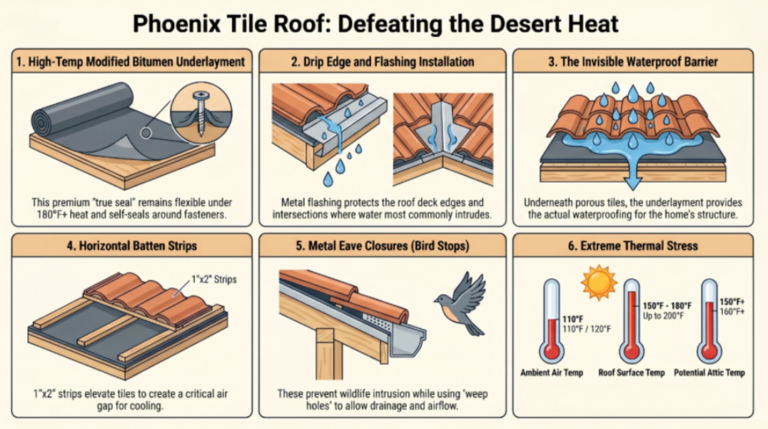
Phoenix roofs are exposed to heat from both directions.
The sun heats the roofing materials from above, while extremely hot attic air affects the system from below.
Ventilation can help move hot and moisture-laden air out of the attic, but it does not turn a Phoenix attic into a cool space. On a summer day, the replacement air entering through vents may already be well over 100 degrees.
Proper ventilation still matters because it supports the roof assembly and helps manage heat and moisture.
However, homeowners should not assume ventilation eliminates the effects of the climate.
Roof design, insulation, attic configuration, intake and exhaust balance, and the roofing system itself all influence how the home handles heat.
Shingle aging is often more visible than tile-underlayment deterioration.
Asphalt shingles contain oils that help them remain flexible. Years of heat and ultraviolet exposure can dry them out and make them more brittle.
Homeowners may notice granules collecting near downspouts, curling edges, cracking, fading, or shingles that lift during wind.
The adhesive seals between shingles may also weaken over time. A shingle can lift during a monsoon storm and settle back into place afterward, making the damage difficult to see from the ground.
Darker shingles may absorb more heat, but color is only one factor. Ventilation, product quality, installation, roof orientation, and sun exposure also influence performance.
A few worn shingles may be repairable. Widespread brittleness, granule loss, and repeated leaks may indicate that the system is approaching the end of its useful life.
For help understanding when repair remains practical, see [Roof Repair vs Replacement in Phoenix].
Foam roofs rely on a protective coating to shield the foam from sunlight.
That coating works much like sunscreen. As long as it remains continuous and in good condition, it protects the foam beneath it from ultraviolet exposure.
When the coating wears thin, the foam may begin to turn orange, chalky, or brittle. Small cracks, worn areas, bird damage, debris impact, or failed transitions may allow moisture into the system.
A foam roof that is maintained can last for many years. Periodic inspections and recoating can restore the protective surface before the foam deteriorates.
Waiting too long can change the project.
What might have been a straightforward recoat may require more extensive repairs, removal of damaged foam, drainage corrections, or replacement of wet areas.
For a more detailed look at project costs, see [How Much Does a Foam Roof Cost in Phoenix].
Water should move off a roof efficiently.
When it does not, the roofing system is exposed to moisture for longer periods. Ponding water can also collect dirt and debris, increase coating wear, and place additional stress on low areas.
On flat and foam roofs, drainage problems may involve low spots, blocked scuppers, clogged drains, or poor slope.
On pitched roofs, debris can collect in valleys or around penetrations and interrupt the intended water path.
A drainage problem may not create an immediate leak. It may slowly weaken the same area every time it rains.
That makes drainage one of the most important parts of a roof inspection, especially before and during monsoon season.
Roofs are most vulnerable where the surface is interrupted.
Vents, pipes, skylights, HVAC curbs, walls, valleys, chimneys, scuppers, and transitions all require special detailing to keep water out.
The main roofing material may still be in good condition while a flashing, sealant joint, or penetration begins to fail.
These areas also experience movement as temperatures change. Sealants can dry out, metal can shift, and old repairs may separate from surrounding materials.
That is why a small leak does not always mean the entire roof has failed.
It may come from one isolated detail.
The challenge is determining whether the problem is truly localized or whether it is one symptom of broader deterioration.
Phoenix roofs may go months without rain.
During that time, sealants can crack, debris can collect, tiles can shift, and coatings can wear without producing an obvious interior symptom.
Then monsoon season arrives.
Strong wind, blowing dust, sudden downpours, and rain moving sideways can force water into weak areas that remained dry during calmer weather.
A roof may leak during one storm and stay dry during the next because wind direction and rainfall intensity changed.
That does not mean the opening repaired itself.
It means the next storm has not yet tested the same weak point in the same way.
For more on this pattern, see [What Happens If You Ignore a Roof Leak During Monsoon Season in Phoenix].
There is no single lifespan that applies to every Phoenix roof.
The ranges below are general planning guidelines rather than guarantees:
Roofing system | Common Phoenix lifespan | What tends to affect it |
Three-tab asphalt shingles | About 10–15 years | Heat, UV exposure, ventilation, product quality and installation |
Tile roof underlayment | About 15–25 years for many standard systems | Material grade, installation, trapped heat, flashing and maintenance |
Foam roof | About 20–40+ years when maintained | Coating condition, drainage, moisture, repairs and recoat history |
Metal roof | Often 40–70 years | System type, finish, flashing, sealants, installation and maintenance |
These ranges can vary substantially.
A roof’s actual life depends on its design, orientation, materials, workmanship, maintenance history, ventilation, drainage, and exposure.
The original installation may matter as much as the age printed on the product warranty.
No. An older roof is not automatically an emergency, and age by itself does not prove that replacement is necessary.
Some older roofs continue performing well because they were installed correctly, maintained consistently, and protected from major damage.
Other roofs fail early because of poor workmanship, incompatible materials, inadequate drainage, or details that were incorrect from the beginning.
The better question is not simply:
“How old is my roof?”
It is: “What condition is the roof in now, and how dependable is the full system likely to be going forward?”
An inspection should consider both age and performance.
Two homes in the same subdivision may have been built in the same year and still need roofing work at different times.
One roof may receive more direct afternoon sun. Another may have better attic ventilation. One may have experienced repeated repairs or storm damage. Another may have been maintained consistently.
The original crews may also have installed certain details differently.
Small differences in flashing, underlayment overlaps, fastening, drainage, and sealant application can produce large differences over 15 or 20 years.
This is why replacing a roof simply because the neighbors replaced theirs may be premature.
It is also why assuming your roof is fine because the neighbor’s roof has not leaked can be risky.
Your roof should be evaluated based on its own condition.
A useful inspection should look beyond the visible covering.
It should consider the age and type of roofing system, the condition of the waterproofing, flashing, penetrations, drainage, previous repairs, visible wear, interior leak evidence, and areas that may require maintenance.
On a tile roof, that may involve evaluating underlayment condition in accessible or representative areas.
On a foam roof, it should include coating thickness, exposed foam, cracks, drainage, transitions, and signs of moisture.
On a shingle roof, the inspector may look for brittleness, granule loss, lifted tabs, flashing problems, and damaged seals.
The goal is not to find a reason to replace the roof.
It is to understand where the roof realistically stands before a leak or storm forces the decision.
For a fuller explanation, see [What to Expect During a Roof Inspection].
Start with the roof’s history.
Find out when it was installed, what materials were used, whether repairs have been completed, and whether maintenance records are available.
Pay attention to warning signs inside the home as well. Ceiling stains, musty odors, damp drywall, peeling paint, and recurring leaks can reveal problems that are not visible outside.
You should also consider the roof’s maintenance needs before monsoon season. Clearing drainage areas, repairing worn sealants, replacing damaged materials, and addressing coating wear may help prevent a more serious leak.
A roof does not need to be visibly failing to benefit from an inspection.
Many aging conditions are still repairable when they are isolated.
A flashing problem, slipped tile, limited shingle area, small foam puncture, or worn sealant may not require full replacement if the surrounding system remains dependable.
Repair becomes less practical when deterioration appears in several locations, leaks keep returning, or the hidden waterproofing has failed across a large section.
The decision should consider both the immediate problem and the condition of the rest of the roof.
For more on limited work, see [Can You Replace Just Part of a Roof in Phoenix].
No roofing system is automatically best for every Phoenix home.
Tile, foam, shingles, and metal respond differently to heat, roof slope, drainage, home design, budget, HOA requirements, and maintenance.
A material that performs well on one home may be inappropriate for another.
The best choice is the system that fits the roof design and can be installed correctly by a crew experienced with that material.
For a broader comparison, see [What Is the Best Roofing Material for Phoenix Homes].
Roofs often fail faster in Phoenix because the environment is unusually demanding.
Heat, ultraviolet exposure, thermal movement, attic temperatures, dust, and monsoon storms all place stress on roofing systems.
But climate is only half of the story.
Installation quality, roof design, drainage, ventilation, maintenance, material selection, and crew experience all influence how long a roof actually lasts.
A roof that looks fine from the street may still have aging underlayment, brittle shingles, worn foam coating, weakened flashing, or drainage problems hidden beneath the surface.
At the same time, an older roof that was installed well and maintained properly may still have useful life remaining.
The only reliable way to know is to evaluate the roof as a complete system—not just judge the material you can see from the ground.
If you are unsure about the condition of your roof, schedule an inspection with Raving Roofs.
We will document what we see, explain how the roof is aging, identify maintenance or repair needs, and help you understand whether the system still has useful life remaining.
The goal is not to replace a roof simply because it is older.
It is to find problems while you still have options—and before the next leak makes the decision for you.