

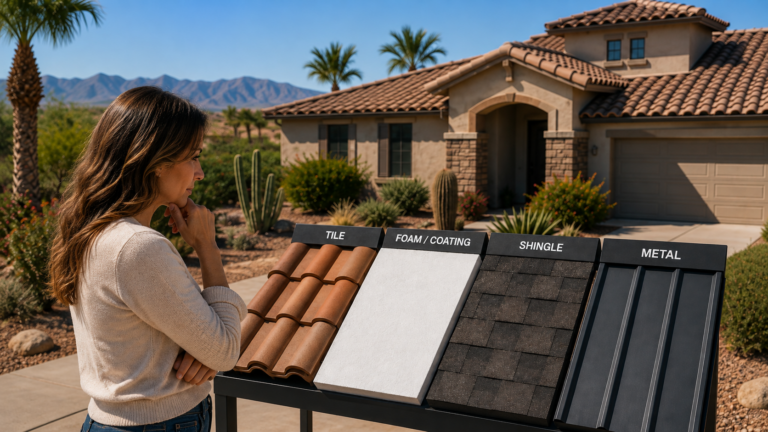
There is no single roofing material that is best for every Phoenix home.
The right choice depends on the roof’s slope, structure, drainage, existing design, HOA rules, budget, maintenance expectations, and how long the homeowner plans to stay in the property.
For many flat or low-slope roofs, spray foam is one of the strongest residential options because it creates a seamless waterproofing surface, adds insulation value, and can often be renewed through recoating instead of being completely replaced.
For many pitched roofs, concrete tile with a high-quality underlayment system offers a strong balance of durability, appearance, and long-term value. Metal can also perform well, although its higher cost and HOA restrictions may limit where it makes sense. Asphalt shingles usually have a lower upfront cost but tend to age more quickly in Phoenix heat.
The best roofing system is the one that fits the home and can be installed correctly.
Homeowners often begin by asking which roofing material lasts the longest or performs best in Arizona.
Those are useful considerations, but the roof itself usually narrows the choices before material comparisons begin.
A flat roof manages water differently from a pitched roof. Some systems are designed to shed rain quickly, while others are designed to waterproof surfaces where water moves more slowly.
Structure also matters. Tile is much heavier than shingles or many metal systems. A home that was not designed to support tile may require structural evaluation before that material can be considered.
The existing roof design, drainage, neighborhood appearance requirements, and available budget may eliminate certain options even when the material sounds appealing.
That is why a roofing recommendation should begin with the home rather than a generic list of products.
Phoenix residential roofs generally fall into two broad categories:
Flat or low-slope roofs need systems that can handle slower drainage, ponding risk, penetrations, parapets, and intense ultraviolet exposure.
Pitched roofs shed water more quickly and are more commonly covered with tile, shingles, or metal.
Some homes have both. A house may have tile over the main pitched roof and foam over a patio, garage, addition, or low-slope section.
Each area should be evaluated according to its own slope and drainage needs.
The fact that one material works well on one part of the home does not mean it belongs everywhere.
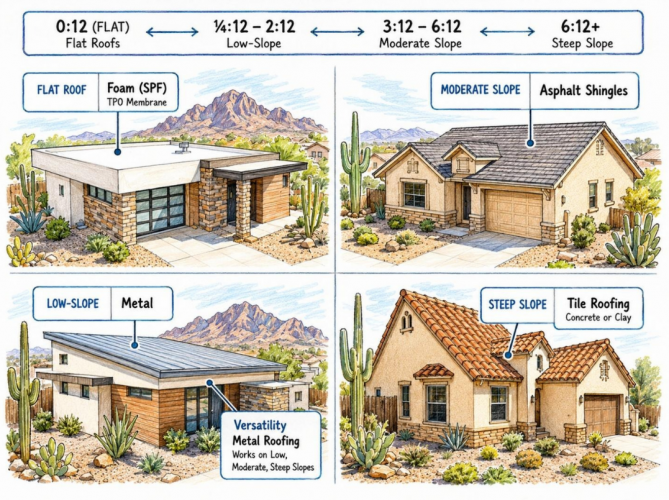
Flat and low-slope roofs need continuous waterproofing.
Because water moves more slowly across these surfaces, seams, drainage paths, scuppers, penetrations, and transitions become especially important.
The most common residential options in Phoenix include spray foam, built-up or rolled roofing, and certain membrane systems.
Spray polyurethane foam, commonly called SPF or foam roofing, is often a strong fit for flat and low-slope homes in Phoenix.
The foam is sprayed directly onto the roof, creating a seamless surface that can conform around penetrations, equipment, walls, and irregular roof details.
It also adds insulation value, which may help reduce heat transfer into the home. A reflective coating protects the foam from ultraviolet exposure and helps manage surface temperatures.
Another advantage is long-term maintainability.
The protective coating wears over time and must be renewed. When maintenance is performed before the foam deteriorates, the roof can often be recoated rather than torn off and replaced.
That makes foam different from systems that eventually require a more complete removal when they reach the end of their useful life.
Foam is generally a strong option for homeowners who want:
The installation still matters. Improper preparation, poor drainage, insufficient coating, or trapped moisture can reduce the system’s performance.
For more on pricing and the factors that affect the project, see [How Much Does a Foam Roof Cost in Phoenix].
The coating over a foam roof protects the foam from sunlight.
As the coating wears, the foam may eventually become exposed. Unprotected foam can turn orange, chalky, brittle, or damaged.
Recoating schedules vary based on the coating system, exposure, drainage, foot traffic, and maintenance history. An inspection can determine whether the roof needs minor repairs, a maintenance coating, or more extensive restoration.
Foam can last for decades when problems are caught early and the protective coating is maintained.
Waiting too long may turn a manageable recoat into a larger repair because deteriorated or wet foam may need to be removed and rebuilt.
Built-up and rolled roofing systems are also found on Phoenix flat and low-slope homes.
These systems are made from layered roofing materials and may provide dependable performance when they are installed correctly.
Some homeowners choose them because they are familiar or because they may require less routine coating maintenance in the early years.
The long-term tradeoff is that renewal can become more involved once the system reaches the end of its service life.
A built-up roof may eventually require substantial removal or replacement. Foam may need more regular attention, but its protective surface can often be renewed without replacing the entire system.
Neither approach is automatically better for every property.
The decision depends on the existing roof, budget, maintenance expectations, drainage, and how the homeowner wants to manage future roofing costs.
TPO and other single-ply membranes are more common on commercial buildings, but they may be used on certain residential flat roofs.
These systems can perform well when the roof design suits them and the installer understands membrane seams, edges, penetrations, walls, and drainage.
Residential fit is an important consideration.
Phoenix homes often have numerous rooftop penetrations, parapets, equipment curbs, and irregular transitions. These details can make membrane installation more labor-intensive and may affect cost.
TPO may be a reasonable option for some properties. Foam is often more practical on residential roofs because it conforms to complicated surfaces and adds insulation value.
The roof should be inspected before deciding which system is better suited to the property.
The most common materials for pitched Phoenix roofs are concrete tile, clay tile, asphalt shingles, and metal.
Each offers a different balance of cost, durability, appearance, maintenance, and compatibility with the home.
Concrete tile is common throughout the Valley. Shingles offer a lower entry price. Metal provides durability at a premium cost. Clay tile offers a distinctive appearance but requires careful handling.
For many pitched homes, concrete tile offers one of the strongest overall combinations of durability, appearance, availability, and neighborhood compatibility.
Concrete tile handles Phoenix heat well and fits the architectural style of many Valley communities.
The tile itself can remain serviceable for decades. The underlayment beneath it usually determines when major roofing work becomes necessary.
That underlayment is the primary waterproofing layer. It protects the home when wind-driven rain passes beneath the tile.
As the underlayment ages, it may become brittle, shrink, split, or deteriorate around fasteners, valleys, and penetrations. The tile can still look good from the street even when the waterproofing beneath it is approaching the end of its life.
Many Phoenix tile projects therefore involve removing and stacking the existing tile, replacing the underlayment and related components, and then reinstalling the reusable tile.
Concrete tile is usually well suited to homeowners who want long-term durability, traditional Arizona curb appeal, and a roofing system that fits many HOA communities.
Homeowners sometimes spend most of their time comparing tile brands and colors.
Those choices affect appearance, but the underlayment and installation details usually have a greater effect on waterproofing performance.
The contractor should explain:
A stronger tile does not compensate for weak waterproofing beneath it.
Installation quality is one reason two tile-roof proposals can differ significantly in price. For more on those differences, see [Why Some Roofing Quotes Are Cheaper Than Others].
Concrete tile is more common throughout Phoenix because it is durable, widely available, and compatible with many residential roof designs.
Clay tile is often treated as a more premium option. It can be attractive and long-lasting, but it is generally more brittle than concrete tile.
That brittleness matters during installation, inspection, repair, HVAC service, solar work, and any other activity that requires roof access.
A clay tile roof can perform very well when the crews working on it understand how to walk, remove, store, and reinstall the material correctly.
The homeowner should consider how often people may need to access the roof and whether replacement tiles will remain available.
Asphalt shingles are often selected because of their lower upfront cost.
They are lighter than tile, widely available, and generally faster to install. They can be a practical choice for pitched roofs that were designed for shingles.
The tradeoff is how they respond to the Phoenix climate.
Heat and ultraviolet exposure can dry the asphalt, weaken seals, loosen granules, and make the shingles brittle. Wind can then lift or damage material that has already been weakened by years of exposure.
Homeowners may notice:
Shingles can still be the right material when upfront cost is a priority and the homeowner understands the expected maintenance and lifespan.
Installation, ventilation, product quality, roof orientation, and color all affect how the system performs.
For more on how different roof systems age in Arizona, see [Why Roofs Fail Faster in Phoenix—Even When They Still Look Fine].
Metal roofing can provide long service life, durability, reflectivity, and a distinctive appearance.
It is often lighter than tile, although the roof still needs to be evaluated for the specific system and installation method.
The main obstacles are cost, design compatibility, and HOA approval.
Metal is usually more expensive upfront than shingles and many tile options. The installation also requires experience with seams, fasteners, panel movement, flashing, penetrations, and transitions.
Phoenix temperature swings cause metal panels to expand and contract. The system must be designed and installed so that movement does not create stress or openings.
Appearance is another factor. Some communities restrict metal roof colors, profiles, reflectivity, or visibility from the street.
Metal may be a strong choice when the roof design supports it, the homeowner is comfortable with the cost, and the neighborhood permits the appearance.
Many Phoenix-area communities regulate exterior roofing materials.
An HOA may control the material type, color, profile, reflectivity, or how visible the roof is from the street.
These restrictions are especially important when a homeowner wants to change from one system to another.
A metal roof may be technically appropriate but prohibited by the community. A new tile may need to match an approved profile or color. Shingle choices may also be limited.
Homeowners should review the community’s architectural guidelines before selecting materials or signing a contract.
Roof repair may require less approval than a visible material change, but community rules vary.
Sometimes, but the change may involve more than removing one roof and installing another.
Switching from shingles to tile may require structural evaluation because tile is significantly heavier.
Changing from tile to metal can affect flashing, ventilation, drainage, panel layout, appearance, and HOA approval.
A flat roof cannot simply receive a material designed only to shed water on a steep slope.
Material changes may also alter how different roof sections connect. A pitched tile roof and adjoining flat foam roof need a carefully designed transition.
In many situations, the most practical approach is to remain within the type of system the home was originally designed to support and choose the best available version of that system.
A premium roofing material can fail early when installation details are incorrect.
An average material can perform very well when the roof is properly prepared, flashed, fastened, drained, and inspected.
Many of the most important details are hidden after the job is complete.
These include underlayment overlaps, flashing, fasteners, penetration details, valleys, drainage, coating thickness, surface preparation, and roof-to-wall transitions.
Phoenix weather tends to expose weak details quickly. Heat dries sealants and stresses materials. Monsoon winds push water into small openings. Heavy rain tests valleys, scuppers, and drainage paths.
The material is important, but it cannot be separated from the system built beneath and around it.
For flat or low-slope roofs, foam is often a strong residential choice because of its seamless waterproofing, insulation value, and ability to be renewed through recoating.
Built-up roofing can also perform well, although the eventual replacement may be more involved.
TPO may suit certain residential roofs, particularly when the design and detailing support a membrane system.
For pitched roofs, concrete tile provides a strong balance of durability and neighborhood compatibility. The underlayment remains the key waterproofing component.
Asphalt shingles usually offer the lowest upfront cost but may require replacement sooner because of Phoenix heat and ultraviolet exposure.
Metal provides long-term durability and reflectivity but comes with a higher initial investment and possible HOA restrictions.
The final decision should account for both installation cost and what the roof will require over its full service life.
The least expensive material is not necessarily the least expensive roof over time.
A lower-cost system may require earlier replacement or more frequent repairs. A more expensive roof may offer longer service life but require a much larger initial investment.
That does not mean every homeowner should choose the premium option.
The best value depends on:
Someone planning to sell soon may reach a different conclusion from someone planning to stay in the home for 20 years.
For a broader look at replacement pricing, see [How Much Does a Roof Replacement Really Cost in Phoenix?].
Some homes have more than one roofing system.
The main pitched roof may be tile while a patio, garage, or addition has foam. That is common and may be entirely appropriate.
Different roof areas can use different materials as long as each system suits the slope and the transitions between them are waterproofed correctly.
A problem in one section does not always mean the entire roof needs to be converted or replaced.
When damage is isolated and the surrounding system remains healthy, partial work may be possible.
For more on that decision, see [Can You Replace Just Part of a Roof in Phoenix].
A roofing contractor should connect the recommendation to the home rather than simply naming a preferred product.
Ask:
The answers should make the advantages and tradeoffs understandable without requiring the homeowner to become a roofing expert.
Before recommending a material, the contractor should inspect the existing roof and determine whether the home needs repair, partial replacement, or a completely new system.
The evaluation should consider the roof’s slope, condition, drainage, structure, penetrations, transitions, existing materials, and areas where water may collect.
The contractor should also ask about the homeowner’s budget, ownership plans, maintenance preferences, appearance goals, and HOA restrictions.
Those details help narrow the options to systems that are realistic for the property.
For a closer look at the process, see [What to Expect During a Roof Inspection].
The best roofing material for a Phoenix home is the one that fits the roof’s slope, structure, drainage, neighborhood requirements, budget, and long-term needs.
For many flat and low-slope roofs, foam offers a strong combination of waterproofing, insulation value, reflectivity, and maintainability.
For many pitched roofs, concrete tile with a high-quality underlayment system provides a practical balance of durability, appearance, and long-term value.
Shingles may be appropriate when lower upfront cost is the main priority. Metal may be an excellent choice when the design, budget, and HOA rules support it. Built-up roofing and membrane systems can also make sense for certain low-slope properties.
No material performs well when it is poorly matched to the roof or installed incorrectly.
The system must fit the home, and the installation must support the way the material is designed to work.
Schedule an inspection and material consultation with Raving Roofs.
We will evaluate the roof’s design, structure, slope, drainage, existing materials, and condition before discussing realistic options.
You will receive a recommendation based on the home you have, the goals you are trying to meet, and the tradeoffs you are comfortable accepting.