

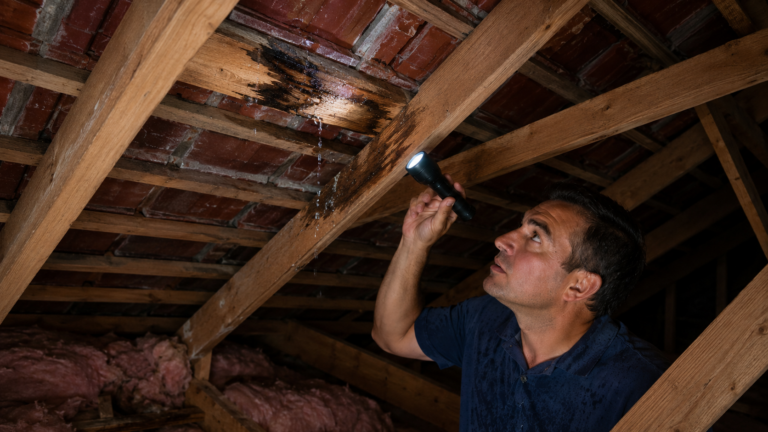
Ignoring a roof leak during Phoenix monsoon season can lead to soaked insulation, damaged drywall, mold concerns, electrical hazards, deteriorated decking, and a much more expensive repair.
What begins as a small ceiling stain or a leak that appears only once may continue allowing water into the roofing system during later storms.
Phoenix roof leaks are often intermittent. A roof may leak during one storm and stay dry during the next because wind direction, rainfall intensity, and pressure have changed.
That does not mean the problem fixed itself.
It usually means the conditions have not exposed the weak point again yet.
One of the most common things homeowners say after a storm is:
“It only leaked once, and it hasn’t happened again.”
That sounds reassuring. If the dripping stopped, it is natural to hope the problem has gone away.
Roof leaks do not always behave that simply, especially during monsoon season.
A small opening may stay dry during light, vertical rain but allow water inside when strong wind pushes rain sideways against it. The same weak point can perform differently depending on the direction and force of the storm.
Think of a small hole in a piece of plywood. If water runs gently down the surface, very little may pass through. If water is sprayed directly at that hole under pressure, much more can get through.
Wind-driven rain can have the same effect on a vulnerable roof detail.
A storm arriving from the northeast may expose one side of the house. A later storm from the southwest may drive water against a completely different wall, flashing detail, penetration, or roof transition.
That is why a leak can appear random even when there is a specific underlying cause.
For help deciding whether the current situation requires immediate action, see [Is a Roof Leak an Emergency].
Phoenix does not usually receive long periods of steady, gentle rain.
Monsoon storms can bring sudden downpours, dust, powerful wind gusts, and rain moving almost horizontally.
Those conditions find weaknesses that may stay hidden during lighter weather.
Water can be forced beneath roof tiles, around flashing, through failed sealants, into roof penetrations, and across low areas of flat roofs. Debris can block drainage, while strong winds may shift tiles or lift shingles.
A roof detail that stays dry during an ordinary shower may leak during a severe monsoon storm because the water is striking the home from a different angle or collecting faster than it can drain.
The leak may still be present after the storm passes. It simply may not appear again until the right combination of wind and rain returns.
Many homeowners picture a roof leak as a straight line: water enters the roof and drips directly onto the ceiling below.
In reality, water often travels before it becomes visible.
It may enter near a broken tile, failed flashing, deteriorated underlayment, worn sealant, skylight, air-conditioning curb, pipe penetration, scupper, parapet, or roof-to-wall transition.
From there, water may move across the roof deck, follow framing, spread through insulation, or travel along pipes before appearing several feet away.
The ceiling stain tells you where the water finally became visible.
It does not necessarily tell you where the roof failed.
This is why simply sealing the area directly above the stain may not solve the problem. The roofer has to trace the likely water path and inspect the surrounding roof system.
Roof-leak damage often develops in stages.
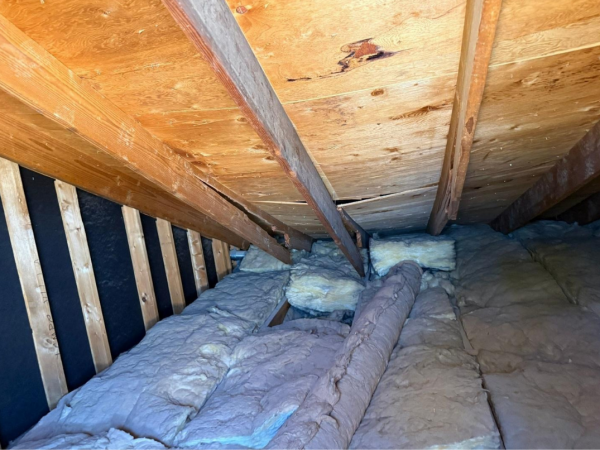
At first, water enters the roofing system without creating an obvious interior sign. Moisture may collect beneath tile, within insulation, along framing, or on top of the ceiling drywall.
Later, the homeowner may notice a faint stain, bubbling paint, a musty smell, damp drywall, or a small drip during heavy rain.
If more storms arrive before the source is corrected, the damage can spread.
The roofing repair may still be relatively limited, but the homeowner may also be dealing with wet insulation, ceiling repairs, interior painting, flooring damage, damaged belongings, or concerns about electrical components and mold growth.
That is where waiting becomes expensive.
The project is no longer only about stopping water at the roof. It may also require repairing the damage the water caused inside the home.
Insulation can absorb and hold moisture without making the full extent of the problem visible from the living space.
A small stain may appear on the ceiling while a much larger area of insulation above it remains wet.
Once insulation becomes saturated, it may lose effectiveness and keep surrounding materials damp. Moisture can also spread beyond the original leak location before dripping through the ceiling.
Phoenix heat does not necessarily dry everything safely or quickly. Moisture can remain trapped between materials, especially when air movement is limited.
The only way to know how far the water traveled may be to inspect the attic or other accessible concealed areas.
For more on what a professional evaluation should include, see [What to Expect During a Roof Inspection].
A homeowner calls after a monsoon storm and says:
“It is probably just a small leak. We only need a patch.”
Sometimes that is correct. The roofer may find one isolated flashing issue, a damaged penetration, a few shifted tiles, or a small foam puncture.
In other cases, the inspection reveals that the water traveled farther than expected. Insulation may be wet several feet from the ceiling stain. The visible leak may be connected to deteriorated underlayment or more than one weak point.
What looked like a small repair from inside the house becomes a larger project because the water continued entering during multiple storms.
The repair did not become larger because the original drip looked dramatic.
It became larger because the moisture had time to spread.
Homeowners often delay a roof repair because they are trying to avoid an unexpected expense.
That is understandable.
The problem is that continued water intrusion can create costs beyond the original roofing repair.
Addressing the leak early may involve a localized repair and limited disruption. Waiting may add damaged insulation, drywall replacement, paint, electrical evaluation, remediation work, or replacement of deteriorated decking.
A leak that could have been corrected at one flashing detail may eventually affect a much larger portion of the roof and interior.
The longer water continues entering, the harder it becomes to keep the solution simple.
Yes.
Not every leak becomes a major roofing failure.
A leak may remain manageable when it is discovered early, the source is truly isolated, and the surrounding roofing system is still in good condition.
The difficulty is that you usually cannot confirm that from inside the home.
A small ceiling stain does not reveal how far water traveled, how long the materials stayed wet, or whether the waterproofing system has other weak areas.
An inspection is not meant to assume the worst or push every homeowner toward replacement.
Its purpose is to determine whether the problem is localized and repairable—or whether the leak is one symptom of broader deterioration.
A targeted repair may be appropriate when the problem involves one damaged flashing, isolated penetration, slipped tile, limited shingle area, or small foam defect.
The repair is more likely to be dependable when the surrounding materials remain serviceable and the roof does not have a history of recurring leaks.
The roofer should be able to explain what caused the leak, what will be repaired, and why the surrounding area appears healthy.
A repair becomes less dependable when leaks have appeared in several locations, the roof is nearing the end of its life, or the underlying waterproofing system is deteriorating across a larger area.
For help understanding that decision, see [Roof Repair vs Replacement in Phoenix].
Tile roofs can look good from the street long after the waterproofing beneath them has started deteriorating.
The concrete or clay tile may still be reusable, but the underlayment beneath it may be dry, brittle, or failing after years of heat exposure.
A storm may break or shift a few tiles and expose the underlayment to more water. It may also reveal a weak area that had already been developing.
Repairing one visible location may solve the immediate leak, but it may not address deterioration elsewhere beneath the tile.
That does not mean every older tile roof needs replacement. It means the contractor should evaluate more than the individual broken tile or ceiling stain.
On foam and other low-slope roofs, water may collect in low areas, move toward penetrations, or enter through damaged coating, transitions, scuppers, or parapet details.
The point where water appears inside may be far from where it entered.
Drainage also matters. Debris or a blocked scupper may cause water to sit longer than usual and expose a weak area that remains dry during lighter rain.
A localized foam repair may be enough when the surrounding foam is dry, stable, and well bonded.
If moisture has spread beneath the system or the coating is failing across a larger area, a broader repair or restoration may be needed.
For more information about foam pricing and project scope, see [How Much Does a Foam Roof Cost in Phoenix].
Wind can lift shingles without removing them completely.
A shingle may settle back into place after the storm and look normal from the ground, even though its seal has been damaged or the material has developed a crease.
Cracked shingles, missing granules, exposed fasteners, and flashing failures can also allow water beneath the roof covering.
These issues may leak only when wind pushes rain beneath the damaged area from a particular direction.
A roof that stays dry during one storm may still have a real vulnerability.
Instead of asking only:
“Is it still leaking?”
Ask:
“What could happen if this roof goes through two or three more monsoon storms without being inspected?”
That is the more useful question.
If the leak depends on wind direction and pressure, it may not appear again until the next storm reaches the weak point at the right angle.
By then, additional moisture may have entered the roofing system or interior.
The absence of another visible drip does not prove that the roof is sound.
Document what you saw, including the stain, active dripping, wet drywall, and any visible exterior damage you can photograph safely from the ground.
Note when the leak appeared, how long it lasted, and whether the storm involved heavy wind, hail, or wind-driven rain.
Do not climb onto the roof during unsafe conditions.
Once the storm passes, schedule an inspection. The roofer should try to identify where the water entered, whether the problem is isolated, how far moisture may have traveled, and whether the surrounding roofing system remains serviceable.
The goal is to correct the source at the roof—not simply repaint the ceiling stain.
A roof can appear normal while hidden components are deteriorating.
Tile may remain in place while underlayment is failing. Shingles may look flat after being lifted by wind. Foam coating may appear intact from a distance while small cracks or worn areas are developing around transitions.
Roofing systems often fail from the inside out or beneath the visible surface.
That is why visual appearance alone does not always indicate how much useful life remains.
For more on hidden deterioration, see [Why Roofs Fail Faster in Phoenix (Even When They Look Fine)].
Possibly.
Partial repairs work best when the damaged area is clearly isolated and can be connected reliably to the surrounding system.
Tile, foam, and some shingle problems may be repairable in sections, depending on the roof design and condition.
Partial work becomes more difficult when deterioration crosses several roof areas or when the waterproofing beneath the visible materials has failed more broadly.
For a fuller explanation, see [Can You Replace Just Part of a Roof in Phoenix].
A roof leak during monsoon season rarely improves on its own.
Phoenix leaks can be intermittent because wind direction, rainfall intensity, and pressure expose different weak points during different storms. A leak that appeared only once may still represent a real problem.
The earlier you understand what is happening, the more options you usually have.
A limited repair may still be possible when the source is isolated and the surrounding roof remains healthy. Waiting through several more storms can add insulation damage, drywall repairs, moisture concerns, and broader deterioration.
Do not assume the roof fixed itself simply because the dripping stopped.
Find out where the water entered before the next monsoon storm tests the same weak point again.
If your roof has leaked—even once—schedule an inspection with Raving Roofs.
We will document the visible conditions, investigate the likely water path, and explain whether the problem appears isolated, storm-related, age-related, or part of a larger roofing issue.
The goal is not to make the problem sound worse than it is.
It is to understand what happened while the repair options are still clear.