

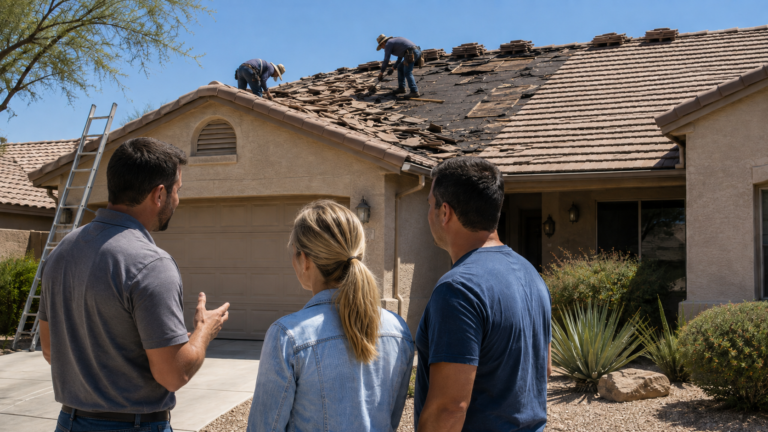
In Phoenix, the real question is often not whether a roof can be repaired, but whether continuing to repair it still makes financial sense.
A targeted repair may be the right choice when the problem is isolated and the surrounding roof remains in good condition. Replacement becomes more reasonable when leaks keep returning, deterioration appears in multiple areas, or the waterproofing system beneath the visible roof materials is reaching the end of its life.
Almost any roof can be patched temporarily. The more important question is whether the repair is likely to provide a dependable solution—or simply buy a little more time before the next problem appears.
When a roofing contractor recommends replacement, most homeowners understandably ask:
Do I really need to replace the whole roof?
It is a fair question. Roof replacement is a major investment, and no one wants to take on that expense unless it is necessary.
The truth is that many roofing problems can be repaired. A skilled technician may be able to stop a leak, replace damaged materials, reseal a penetration, correct flashing, or repair a limited section of the roof.
But being able to repair something does not automatically mean repair is the best long-term choice.
Roofing systems rarely fail all at once. More often, homeowners begin seeing smaller warning signs over time: a leak after a storm, slipped tiles, ceiling stains, brittle shingles, worn foam coating, or repairs that keep appearing in different areas.
At first, a targeted repair may extend the roof’s life for several years.
Eventually, though, the homeowner may need to ask a different question:
Are we correcting an isolated problem, or are we repeatedly patching an aging roof?
Repair is often appropriate when the problem is limited and the rest of the roofing system remains serviceable.
That may include a damaged flashing detail, a leaking penetration, a few slipped or broken tiles, a localized foam puncture, a small shingle area, or damage caused by a specific storm event.
Age matters, but it should not be the only deciding factor.
A relatively young roof with one isolated problem is usually a better repair candidate than an older roof with recurring leaks and widespread deterioration. However, installation quality and maintenance history can matter just as much as age.
Some roofs fail earlier than expected because they were installed poorly. Others remain serviceable longer because the homeowner maintained them and addressed small problems before they spread.
A repair makes the most sense when the contractor can clearly explain:
For a closer look at common repair pricing, see [How Much Roof Repair Costs in Phoenix (What Homeowners Actually Pay)].
Many roof leaks begin as small maintenance issues.
Sealants around vents and penetrations dry out. Flashing loosens. Pipe boots crack. Tiles slip. Debris blocks valleys or drainage paths. Foam coatings wear thin.
These conditions may not require major roof work when they are caught early.
A professional inspection may identify smaller issues before they lead to interior water damage or a more expensive repair. That is especially valuable in Phoenix, where extreme heat, ultraviolet exposure, dust, and monsoon storms can accelerate deterioration.
Maintenance cannot make an aging roof last forever, but it can help homeowners get the full useful life from a roof that is still in otherwise good condition.
For more on hidden deterioration, see [Why Roofs Fail Faster in Phoenix (Even When They Look Fine)].
Repair becomes less attractive when the roof is no longer failing in one isolated location.
Common warning signs include:
These signs look different depending on the roofing system.
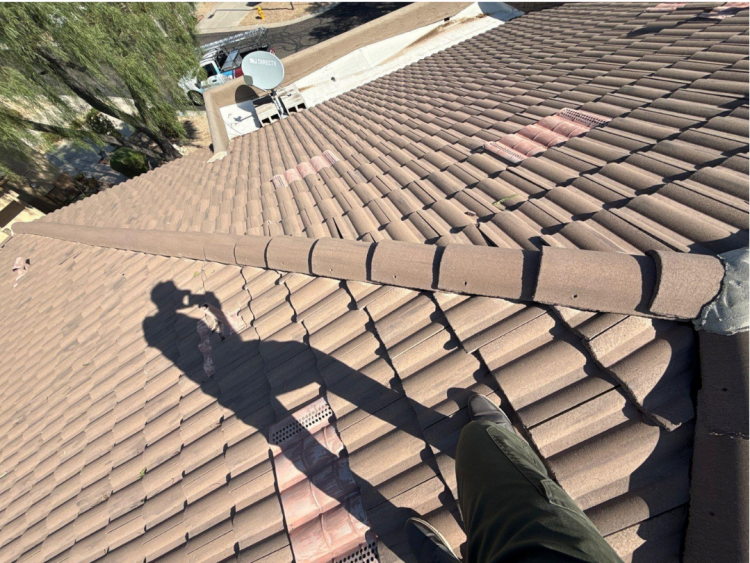
On a tile roof, the visible tiles may still look acceptable while the underlayment beneath them has become dry, brittle, and unreliable after years of heat exposure.
On a shingle roof, widespread granule loss, cracking, curling, loosened shingles, and recurring leaks may indicate that the system is approaching the end of its useful life.
On a foam roof, isolated damage may be repairable, but widespread moisture, deteriorated foam, poor drainage, or extensive coating failure may require a larger solution.
The issue is not whether one more patch is physically possible. It is whether that patch is likely to provide value.
Sometimes.
Whether partial work makes sense depends on the roofing system, the location of the damage, and how the affected area connects to the rest of the roof.
Tile roofs can sometimes be repaired in sections, especially when the roof design provides a natural stopping point. Foam roofs may also allow localized repairs or restoration when the surrounding foam remains dry and well bonded.
Shingle roofs can be more difficult to divide cleanly once deterioration becomes widespread.
Partial replacement works best when the problem is clearly limited and the new work can transition reliably into the existing roofing system.
It becomes less practical when water is moving beneath a larger area or when several sections are beginning to fail.
For a fuller explanation, see [Can You Replace Just Part of a Roof in Phoenix].
Roofing decisions are not made in a vacuum.
A homeowner may understand that the roof will eventually need replacement but still choose a repair because replacement is not financially realistic at that moment.
Some homeowners plan to sell soon. Others live on fixed incomes, face other major expenses, or simply need time to prepare for a larger project.
In those circumstances, a repair may be a reasonable short-term decision even when it is not the ideal long-term solution.
A good roofing contractor should explain that honestly.
The homeowner deserves to know whether the repair is expected to solve an isolated problem or simply provide additional time. That allows the decision to be made with realistic expectations rather than pressure.
One repair may feel manageable.
Several repairs over a period of years can add up quickly.
Each service visit includes diagnosis, travel, setup, labor, materials, and the work itself. When leaks begin appearing in different areas, homeowners may spend thousands of dollars without meaningfully improving the overall condition of the roof.
At some point, repeated repairs can become more expensive than addressing the larger problem.
There is no universal dollar amount where repair automatically becomes the wrong choice. However, it is reasonable to reconsider the strategy when the proposed repair is a significant percentage of replacement cost, especially if the roof is already old or other areas are likely to fail soon.
A less expensive repair may still be the right choice. But the homeowner should understand what that money is buying.
Is it correcting a dependable, isolated issue?
Or is it postponing a larger project while the rest of the system continues to deteriorate?
For a better understanding of full replacement costs, see [How Much Does a Roof Replacement Really Cost in Phoenix?].
Repair warranties are usually more limited than warranties on a full roof replacement.
That does not mean the repair is unreliable. It means the contractor is addressing a specific area rather than resetting the condition of the entire roof.
A contractor may be able to warranty the materials and workmanship in the repaired section. It generally cannot guarantee unrelated portions of an older roof that continue aging independently.
This distinction is especially important when the roof has several weak areas.
A repair warranty should explain:
A homeowner should not assume that repairing one leak creates a warranty for the entire roof.
A replacement recommendation is not automatically unreasonable, but the contractor should be able to explain it clearly.
A thorough inspection should include photos, a description of what is failing, the extent of the deterioration, and an explanation of why repair may or may not provide a dependable result.
The contractor should also discuss realistic alternatives.
If repair is possible but short-lived, say so. If replacement is recommended because the waterproofing system is failing across several areas, the homeowner should be shown the evidence.
Be cautious when someone jumps immediately to replacement without explaining the condition of the roof or discussing whether a repair is practical.
It is reasonable to ask questions or seek another opinion when the recommendation is unclear.
For more on what a professional evaluation should include, see [What to Expect During a Roof Inspection].
There is no single factor that decides whether a roof should be repaired or replaced.
The decision usually depends on the combination of:
Consideration | Repair may make sense when… | Replacement may make sense when… |
Roof condition | Most of the system remains serviceable | Deterioration is widespread |
Problem area | Damage is clearly isolated | Problems appear in multiple areas |
Leak history | This is the first or an infrequent leak | Leaks keep returning |
Waterproofing | Underlayment or membrane remains dependable | The waterproofing system is failing |
Repair cost | The repair is limited and offers useful life | Repairs are becoming large or frequent |
Ownership plans | The homeowner needs a short-term solution | The homeowner plans to stay long term |
Maintenance history | The roof has been maintained | Years of deferred maintenance have accumulated |
Storm damage | Damage is localized | The storm exposed broader deterioration |
The decision should not be based on roof age alone.
Two homes with similar leaks may need completely different solutions because one has an isolated flashing problem while the other has widespread underlayment failure.
Repair is not automatically the “cheap” choice, and replacement is not automatically the “better” choice.
The right decision is the one that matches the roof’s condition, the homeowner’s goals, and the likely long-term cost.
A small stain does not always mean a small problem.
Water may enter in one area, travel beneath the roofing materials, move along framing, and appear somewhere else inside the home.
That means the visible stain may not show the true size or location of the problem.
A small leak can come from a localized issue. It can also be the first visible sign of a larger roofing failure.
That is why the inspection should examine more than the area directly above the stain.
For help determining how urgent the situation may be, see [Is a Roof Leak an Emergency].
A repairable problem may become more difficult and expensive when moisture continues entering the roofing system.
Wet insulation, damaged decking, deteriorated wood, and recurring interior damage can expand the scope beyond the original leak.
This is particularly important during monsoon season, when several storms may arrive close together.
A small opening that allowed limited water during one storm may admit much more during the next, especially if wind direction or rainfall intensity changes.
For more on the risks of delaying action, see [What Happens If You Ignore a Roof Leak During Monsoon Season in Phoenix].
Before approving a repair or replacement, ask the contractor:
A contractor should be able to answer those questions without pressuring you toward the most expensive option.
Repair makes sense when the problem is isolated and the rest of the roof still has meaningful life remaining.
Replacement becomes more reasonable when leaks are recurring, deterioration appears across several areas, the waterproofing system is failing, or repair costs are only delaying a larger project.
This is not simply a choice between spending less and spending more.
It is about understanding what the roof needs now, how dependable each option is likely to be, and which decision makes the most sense for your home, timeline, and financial situation.
When you are unsure whether to repair or replace the roof, begin with a thorough inspection.
At Raving Roofs, we document the condition of the roof, explain whether the problem appears isolated or widespread, and discuss the realistic benefits and limitations of each option.
The goal is not to replace a roof that can still be repaired reliably.
It is also not to keep charging for patches when the larger system has stopped providing dependable protection.