

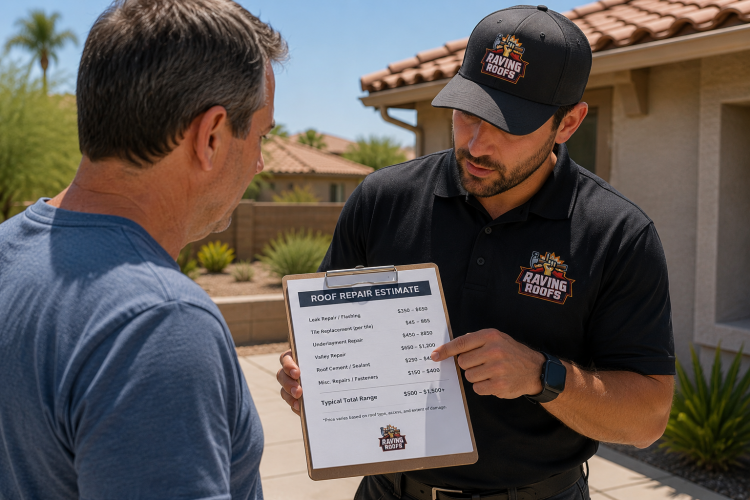
Most roof repairs in Phoenix cost between $300 and $3,500 or more, depending on the roof type, location of the damage, access, labor, and whether hidden problems are discovered during the inspection.
A small repair around a pipe, vent, or flashing detail may cost a few hundred dollars. Repairs involving tile underlayment, foam damage, flat-roof leaks, difficult access, or concealed moisture can reach several thousand dollars.
The visible problem does not always reveal the full scope. A small ceiling stain may come from a simple flashing failure, or water may have traveled beneath the roofing system before appearing inside the home.
A professional inspection is usually necessary before a contractor can provide a reliable price.
Homeowners sometimes compare the repair bill with the amount of time the crew spends on the roof.
For example, a tile repair may cost $500 or $600 even though the visible work takes only 90 minutes. It is understandable to wonder why such a short repair costs that much.
The time on the roof is only one part of the job.
The contractor also has to inspect and diagnose the problem, prepare the scope, schedule the work, load tools and materials, travel to the property, protect the work area, complete the repair, clean up, document the results, and support the workmanship afterward.
For many smaller repairs, materials are not the largest expense. Labor, transportation, insurance, equipment, diagnosis, project coordination, and warranty responsibility all contribute to the price.
That is why two repairs that look similar from the ground can cost very different amounts once the roof is examined.
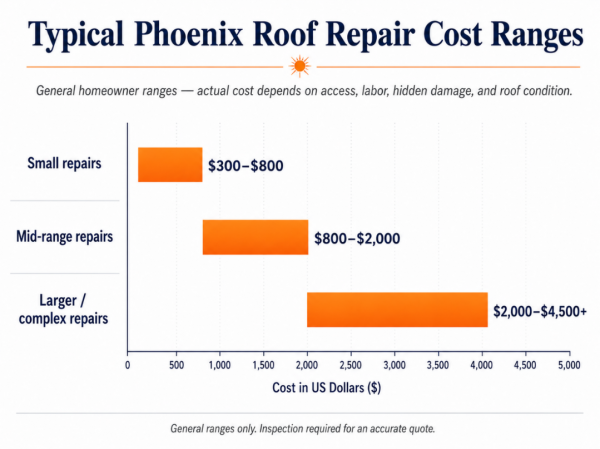
As a general planning guide, Phoenix homeowners may see the following ranges:
Small repairs: $300–$800
These may include resealing a penetration, replacing a few damaged materials, or correcting a small, clearly isolated issue.
Mid-range repairs: $800–$2,000
These often require more investigation, removal of surrounding roofing materials, underlayment work, flashing repairs, or access to a difficult area.
Larger or more complex repairs: $2,000–$4,500 or more
These may involve a larger section of underlayment, concealed wood damage, widespread moisture, extensive foam preparation, several leak points, or difficult roof access.
These ranges are not guarantees. Roof height, pitch, roof type, urgency, material availability, concealed damage, and the amount of diagnostic work can all affect the final cost.
Tile roof repairs in Phoenix often range from approximately $500 to $2,500 or more.
Common problems include broken or slipped tiles, damaged mortar, exposed underlayment, failed flashing, and leaks around valleys or penetrations.
Some tile problems are mostly cosmetic. A concrete tile may crack because of age, movement, falling debris, foot traffic, or an impact. Replacing that tile may be fairly straightforward when the waterproofing beneath it remains intact.
Leaks are usually more involved.
Tile itself is not normally the primary waterproofing layer. The underlayment beneath the tile is what keeps water out of the home.
To repair that layer, the crew may need to remove and stack surrounding tiles, expose the damaged area, repair or replace the underlayment and flashing, and then reinstall the tile without damaging nearby materials.
This work can become more expensive when the roof is steep, the tile is fragile, the leak is near a valley, or the affected area is difficult to reach.
The tile may be inexpensive. Accessing and rebuilding the waterproofing beneath it is often where much of the labor occurs.
Shingle repairs in Phoenix commonly range from about $300 to $1,500 or more.
Many shingle leaks develop around vents, plumbing pipes, flashing, and other places where something passes through the roofing system.
In a simple case, the contractor may clean the area, remove failed sealant or patching material, and rebuild the waterproofing detail.
The condition of the surrounding shingles can change the scope.
Phoenix heat and ultraviolet exposure can make older shingles brittle. They may crack, split, or lose granules when lifted during repair work. A small penetration repair can expand when the adjoining shingles cannot be removed and reinstalled safely.
Shingle repairs are generally more predictable when the roof is still relatively young and the surrounding materials remain flexible.
On an older roof with widespread brittleness, the repair may require replacing a larger area than the original leak suggested.
For more on how Phoenix conditions affect shingles and other roof systems, see [Why Roofs Fail Faster in Phoenix—Even When They Still Look Fine].
Flat and rolled-roof repairs often cost between $500 and $2,500 or more.
Common problems include seam failures, splits, deteriorated patches, punctures, drainage issues, and leaks near walls, penetrations, parapets, or rooftop equipment.
A lifted seam may create a small opening sometimes described as a “fish mouth.” When the surrounding material remains in good condition, the contractor may be able to secure and patch the affected area.
Flat-roof leaks can be difficult to trace because water does not always appear directly below the entry point.
It may move beneath the roofing system before reaching the interior. A ceiling stain could appear 10 or 20 feet away from the original opening.
The repair cost may therefore depend more on diagnosis than on the size of the visible stain.
The contractor may need to inspect seams, drainage paths, previous repairs, wall transitions, scuppers, penetrations, and several possible entry points before finding the source.
Foam roof repairs in Phoenix often range from approximately $500 to $2,000 or more.
Typical issues include cracks, punctures, blisters, worn coating, ponding water, and damage near scuppers, drains, air-conditioning equipment, parapets, and roof penetrations.
A small blister or puncture may be repairable when it is caught early. The damaged section can often be opened, dried or prepared, filled, sealed, and recoated.
The condition of the surrounding coating matters.
Foam relies on its protective coating to shield it from sunlight. When that coating wears away, the exposed foam may become orange, chalky, brittle, or damaged.
A repair that would have been simple earlier may require more preparation after the foam has deteriorated. Wet or badly damaged material may need to be removed before the area can be rebuilt.
Drainage also affects the repair. A crack or blister may return when ponding water or poor slope is the underlying cause.
For a broader explanation of foam roof pricing, see [How Much Does a Foam Roof Cost in Phoenix].
Flashing and penetration repairs often range from $300 to $1,500 or more.
Flashing protects areas where the roof changes direction or meets another surface. These locations include vents, skylights, chimneys, parapets, walls, valleys, and roof-to-wall transitions.
These details are common leak points because they involve seams, fasteners, sealants, and different materials meeting one another.
A simple repair may involve rebuilding the seal around a pipe or vent. A more complicated project may require removing surrounding tile, shingles, foam, stucco, or wall materials to repair the waterproofing correctly.
Wall flashing can be especially difficult to diagnose. The roof surface may appear intact while water is entering where the roofing material meets a vertical wall.
Catching these problems early can help keep the repair contained.
Roof leak repairs commonly range from approximately $400 to $4,000 or more.
The wide range reflects how many different problems can cause a leak.
A small, recent leak around a vent may be relatively straightforward. A leak that has remained active through several storms may involve wet insulation, deteriorated decking, damaged underlayment, rotted wood, or more than one entry point.
The location of the ceiling stain does not always reveal the source.
Water may enter through one section of the roof, travel along framing or beneath the roofing system, and appear somewhere else inside the home.
That is why a contractor may need to inspect a much larger area than the stain itself.
A leak discovered early on an otherwise healthy roof may remain a limited repair. The cost can rise quickly when moisture has spread or the surrounding roof is already deteriorating.
For more on how quickly leak damage can grow, see [What Happens If You Ignore a Roof Leak During Monsoon Season in Phoenix].
Several factors determine whether a repair falls near the low or high end of the range.
The size and location of the problem
A clearly isolated issue generally costs less than damage that spans several areas.
Location also matters. A small defect in an open, accessible section may be easier to repair than the same defect near a valley, wall, skylight, HVAC curb, or roof transition.
Steep roofs, two-story homes, narrow side yards, pools, landscaping, walls, and limited equipment access can add labor and safety requirements.
A complicated roof may take longer to stage and protect before the repair even begins.
Each roofing system requires a different repair process.
Tile often needs to be removed and reset. Shingles may be brittle. Foam requires compatible preparation and coating. Flat roofs may require more investigation because water can travel beneath the surface.
Some leaks are visible as soon as the roofer reaches the roof.
Others require tracing water paths, lifting materials, examining the attic, testing suspected areas, or reviewing previous repairs.
The time required to find the source is part of the repair.
Concealed damage is one of the largest pricing variables.
Once the area is opened, the contractor may discover wet insulation, deteriorated decking, damaged underlayment, rotted wood, or previous repairs that need to be removed.
This does not happen on every job. The contractor should explain how unexpected damage will be handled and priced before the work begins.
Older tile profiles, discontinued shingles, specialty metal parts, and certain coating products may be difficult to match or obtain.
The repair may require additional sourcing, compatible alternatives, or a larger replacement area when the original material is no longer available.
A minimum repair price is common because every project requires a certain amount of work regardless of size.
The contractor still has to schedule the appointment, prepare the crew, load the vehicle, travel to the property, set up safely, diagnose the issue, complete the work, clean up, and document the repair.
A technician may also need to carry several possible materials because the exact condition cannot always be confirmed until the roof is accessed.
The homeowner is paying for more than the sealant, tile, shingle, or patch.
The price includes the ability to diagnose the problem correctly and take responsibility for the work afterward.
Repair is often the right choice when the problem is isolated and the surrounding roof remains dependable.
Examples may include:
A repair can extend the roof’s useful life when the contractor is working from a clear diagnosis rather than guessing.
The remaining roof should also have enough life left to support the new work.
For a deeper discussion of this decision, see [Roof Repair vs Replacement in Phoenix].
One repair does not mean the roof needs replacement.
Repeated repairs in different areas may indicate that the system is aging more broadly.
A homeowner might repair one leak this year, another after the next monsoon, and a third problem the following season. Each project may seem manageable, but the total cost can become substantial.
The pattern matters as much as the price of the current repair.
A larger repair can still be worthwhile when it is expected to provide several more years of dependable performance. The value becomes less clear when the surrounding roof is likely to develop new problems soon.
Once repair costs move into the low thousands or begin involving an entire slope or major section, it is reasonable to compare the repair with partial or full replacement.
That comparison should include the expected lifespan of each option, not only the immediate cost.
For more on replacing a defined roof area, see [Can You Replace Just Part of a Roof in Phoenix].
Not necessarily.
Two contractors may diagnose the same visible symptom differently.
One may propose sealing the area where the leak appeared. Another may recommend removing surrounding materials, rebuilding the flashing or waterproofing, and correcting the source beneath the surface.
The second repair will likely cost more because it includes a larger scope.
That does not automatically make it better. The contractor should be able to explain why each step is necessary and show the condition with photos or video.
When estimates differ significantly, compare the work being proposed, the materials, the warranty, and how hidden damage will be handled.
For more guidance, see [Why Some Roofing Quotes Are Cheaper Than Others].
A clear proposal should describe the specific area being repaired and the work the contractor plans to complete.
It should identify the materials when possible, explain whether surrounding components will be removed or reused, and describe what happens if concealed damage is found.
The proposal should also make the warranty boundaries clear.
A repair warranty generally applies to the work performed. It does not automatically cover unrelated sections of an older roof.
Before approving the work, make sure you understand:
Written details make it easier to compare options and avoid misunderstandings later.
The roofer should examine both the visible problem and the surrounding system.
That may include checking the roof surface, flashing, penetrations, drainage, valleys, previous repairs, and areas where different materials meet.
When safely accessible, the attic may also help reveal wet insulation, staining, damaged decking, or the direction water traveled.
The inspection should establish whether the issue is isolated, how much work is needed to reach it, and whether the surrounding materials are healthy enough to support the repair.
For more on the evaluation process, see [What to Expect During a Roof Inspection].
No, but active water intrusion should be taken seriously.
A leak becomes more urgent when water is entering quickly, the ceiling is sagging, moisture is near electrical fixtures, or more storms are approaching.
A small stain with no active dripping may allow enough time to schedule an inspection under safe conditions. It should not be ignored simply because the rain stopped.
For guidance on immediate steps and warning signs, see [Is a Roof Leak an Emergency].
Most roof repairs in Phoenix cost between $300 and $3,500 or more, but the visible damage alone does not determine the price.
Roof type, access, diagnosis, labor, hidden moisture, material condition, and the extent of the waterproofing repair all affect the final scope.
A small repair may be exactly what the roof needs. A larger repair can also make financial sense when it provides several more years of dependable service.
Repeated repairs deserve a broader conversation when the roof is deteriorating in several areas or the waterproofing system is reaching the end of its life.
The best repair is not always the least expensive one. It is the repair that addresses the source of the problem and fits the condition of the surrounding roof.
Schedule a roof inspection with Raving Roofs to determine what is causing the problem and how much of the roofing system is affected.
We will document what we find, explain the proposed repair, and discuss any conditions that could change the final cost.
You will be able to decide based on the actual condition of the roof rather than the size of the stain or a price guessed from the ground.